Intelligent Bus System (IBS), a satellite based communications technology, is used to improve the tracking of buses, collection of data and communication between Pace and its drivers and passengers. Completed in March 2005, the IBS system allows Pace to greatly improve routing and scheduling because of the valuable data generated on ridership and route efficiency. There are several components that provide Pace with data to improve bus schedules, add or reduce buses as dictated by ridership and track buses in the event of an emergency. IBS can also be a vital statistical provider during present and future restructuring initiatives. With the use of IBS, Pace can collect data in quantities that until now were impossibly cost-prohibitive, which will lead to great improvements in suburban public transportation.
IBS Components
Computer Aided Dispatch (CAD)
The CAD function provides for data and voice communication that can be generated by the dispatchers, mobile users (to replace voice communications) or it can be generated by the system, for example, to provide vehicle status information.
Automatic Vehicle Location (AVL)
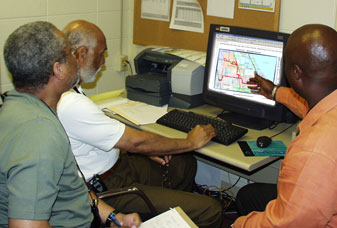
The AVL function uses Global Positioning System (GPS) receivers on-board the buses to provide real-time vehicle location to the dispatchers on map displays and to the on-board functions such as the automated next stop audio and visual announcements. AVL is also the enabler of the Pace Bus Tracker. Based on the data provided by the AVL function, riders can access Pace Bus Tracker via the internet to obtain real-time data on bus arrival times. The AVL function also interacts with other databases to monitor and report each bus's Schedule and Route Adherence. The AVL function improves communication between Pace staff and between Pace and its riders, which enables all parties to make informed decisions.
Transit Signal Priority (TSP)
When buses are behind schedule special devices on the buses send signals to detectors installed at traffic-signal controlled intersection, which automatically give the bus priority by extending a green, shortening a red or providing queue jumps. TSP is a great benefit because it ensures schedule adherence and improves travel times along busy arterial routes.
Automatic Passenger Counters (APC)
Between twenty and twenty-five percent of the buses are equipped with sensors and processors that detect passengers boarding and alighting the buses. Combined with AVL location data, Pace can record the number of passengers boarding and alighting buses at each bus stop. This feature provides Pace with data that improves planning.
Engine/Transmission/ Lift Monitoring
Each vehicle's engine and transmission performance indicators are wired to the on-board computer, which sends alarms to the dispatcher when there is a problem. The wheelchair lift activation sensors are also wired to the on-board computer for monitoring. This, along with AVL, provides Pace with data on the number of times and locations at which wheelchair lifts are used. This is beneficial for maintenance purposes and to allow Pace to keep more accurate data on lift usage.
Transfer Connection Protection
In the past, when passengers wanted to request transfers between routes, the bus operator of the bus with the requesting passenger contacted the bus operator of the connecting bus directly via a bus-to-bus radio call. With AVL, the process is automated in order to eliminate the need for a voice conversation. The bus operator with the requesting passenger contacts the bus operator of the connecting bus by sending a request with the mobile data terminal. This function improves communication between drivers and improves connection reliability for riders.
Police Jurisdiction Pop-Ups
This function allows the dispatcher to click on any point on the geographic map display and the screen displays the name and telephone number of the responsible police department. This function is essential to reduce emergency response times, especially considering Pace buses operate within hundreds of police jurisdictions.
Interface to Passenger Services Representatives
IBS provides near-real-time information concerning bus locations and delays to the RTA Trip Planning System, the Illinois Transit Hub, and customer service representatives. This function should improve customer satisfaction because customers receive real-time, accurate information.
Audio and Visual Announcements
All Pace buses are equipped with an audio enunciator and visual display that automatically announce stops, points of interest and other important information. All buses are also equipped with an exterior enunciator. This provides passengers at bus stops with information about the bus's route and its destination. This amenity is particularly important for people who are visually impaired.
Mobile Data Terminals
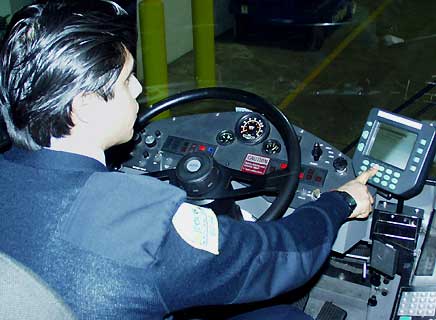
Every bus has a mobile data terminal that allows drivers to send and receive messages, trigger alarms and monitor their schedule adherence. Supervisor vehicles are also equipped with mobile data terminals (notebook computers) that allow the supervisors to view a subset of the CAD/AVL displays, fill out reports, and receive emergency alarms.